

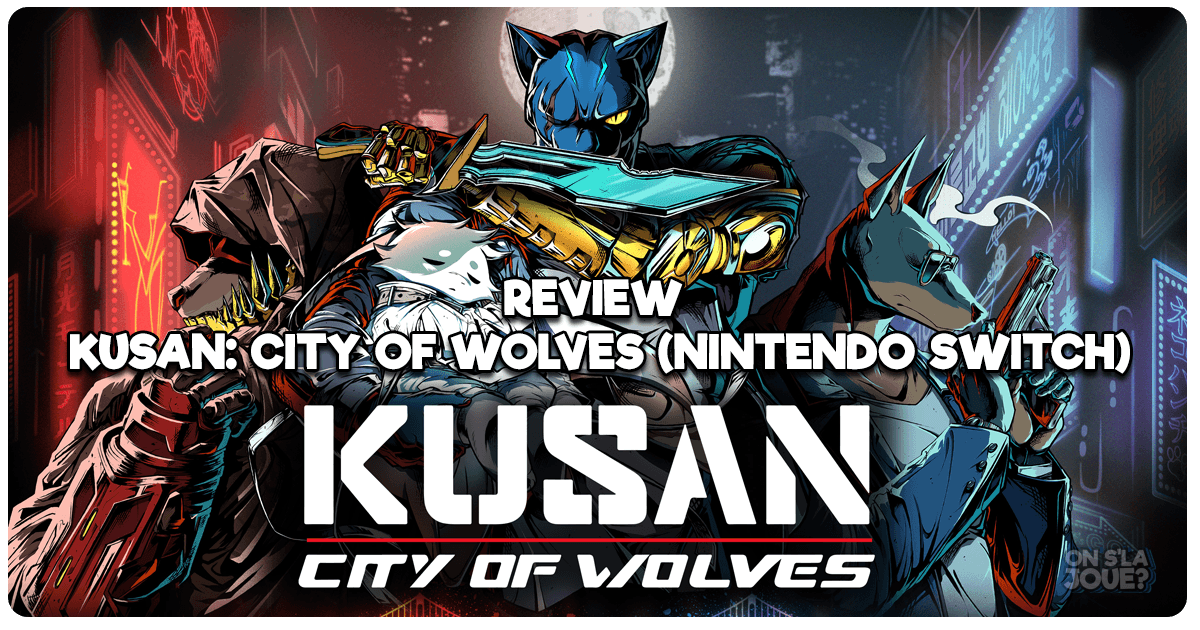
Kusan: City of Wolves transports us to a gritty and dystopian cyberpunk metropolis illuminated by neon lights, where corruption, organized crime, and relentless violence have become part of daily life. Players take on the role of Jin through over 54 hand-crafted and unforgiving levels, as a former elite soldier who now works as a fixer and is entrusted with protecting Haru, a mysterious young girl whose extraordinary abilities have placed her in the crosshairs of multiple dangerous factions. Combining familiar themes of revenge, redemption, and loyalty with a cyberpunk panache, the game draws inspiration from action flicks and fast-paced shooters such as Hotline Miami and Ruiner. The end result is an unforgiving top-down action game that rewards precision, tactical decision-making, and flawless execution in every encounter.
The game released on July 30, 2026, and is available on PlayStation 5, Xbox Series X|S, PC, and Nintendo Switch. The Nintendo Switch version was used for this review.
I would also like to thank CIRCLEfromDOT and PQube for providing the key used to test the game. This key was obtained through a collaboration with Keymailer.
Kusan: City of Wolves immediately impressed me with its immaculate cyberpunk presentation. Every level is drenched in neon lighting and packed with gritty urban environments, from rain-soaked alleyways and abandoned warehouses to industrial complexes and crime-infested districts. Rather than aiming for photorealism, the game relies on a top-down perspective, minimalistic and pixelated art style that effectively capture the bleak atmosphere of its dystopian setting. This choice of aesthetic certainly gave agency to my own imagination.
Character models are decently crafted, and animations are fluid throughout combat. Jin’s movements feel smooth and responsive, while enemy deaths, explosions, muzzle flashes, and other visual effects give each firefight an energetic, cinematic feel. Despite the fast-paced action, the screen rarely feels cluttered, allowing me to stay focused on the chaos unfolding around me.
Given the Nintendo Switch’s well-known hardware limitations, I played Kusan: City of Wolves on my Nintendo Switch 2, despite the absence of a native Switch 2 version. As expected, the game makes a few visual concessions, including softer textures and a slight reduction in image sharpness compared to its counterparts on more powerful platforms. Even so, its overall presentation remains impressive. Whether playing docked or in handheld mode, the game’s distinctive cyberpunk aesthetic shines through, making it a visually rewarding experience regardless of how you choose to play.
I am happy to confirm that performance is also generally reliable. Most of the campaign runs smoothly, although I encountered occasional frame rate dips during particularly intense battles filled with enemies, explosions, and particle effects. Fortunately, these moments were brief and never became disruptive enough to affect my enjoyment.
Ultimately, Kusan: City of Wolves demonstrates that a strong artistic direction can be just as impactful as cutting-edge graphics. Although the Nintendo Switch version may make a few technical concessions, it successfully preserves the game’s stylish cyberpunk identity and delivers a visually engaging experience from beginning to end. I will certainly buy this title on my other platforms of choice.
Gameplay is easily the highlight of this title. From the opening mission, I was immediately immersed in fast-paced combat that constantly tested my reflexes, precision, and ability to think on my feet. Charging into battle without a plan almost always led to a quick death, forcing me to analyze enemy positions, adapt to every encounter, and execute my strategy with care. While the game can be unforgiving, each defeat encouraged me to improve rather than leaving me feeling discouraged.
Jin’s arsenal remains engaging throughout the campaign thanks to its wide variety of weapons and abilities. Whether I was wielding a devastating shotgun, a precise rifle, or a rapid-fire weapon, each firearm had its own strengths and encouraged different approaches to combat. His mechanical arm and melee attacks add another layer of depth, allowing me to seamlessly transition between close-quarters combat and ranged engagements. Unlocking additional weapons and abilities kept the gameplay fresh, as I was constantly experimenting with new loadouts to overcome increasingly demanding encounters.
Enemy variety also plays a major role in keeping combat engaging. Each enemy type presents its own challenge, requiring me to adapt my tactics instead of relying on the same approach every time. Some enemies aggressively rush my position, while others attack from a distance or require more careful planning to defeat. This diversity ensures that every firefight feels dynamic and rewarding from beginning to end.
Another aspect I appreciated was the generous checkpoint system. Despite the game’s high difficulty, frequent checkpoints minimize frustration by placing me just before the next encounter instead of forcing me to replay lengthy sections. The result is a rewarding trial-and-error gameplay loop where every failure becomes a valuable learning experience.
I was also impressed by how well the controls translate to my Nintendo Switch 2. Whether I played in handheld mode or with a controller while docked, movement remained responsive and aiming felt natural. Even during the most chaotic battles, the controls never got in the way, allowing me to focus entirely on the action unfolding on screen.
Although Kusan: City of Wolves is unapologetically gameplay-driven, I found its narrative compelling enough to keep me invested throughout the entire campaign. Set within a bleak cyberpunk metropolis where corruption, organized crime, and violence dictate everyday life, the story follows Jin, a former elite soldier turned fixer who is hired to protect Haru, a mysterious young girl whose extraordinary abilities have placed her in the sights of multiple powerful factions. What initially appears to be a straightforward protection mission gradually evolves into a far more intricate tale filled with conspiracies, betrayals, and revelations that continually reshape the stakes.
The narrative embraces many of the genre’s defining themes, including revenge, redemption, sacrifice, loyalty, and the abuse of power. Rather than attempting to subvert familiar cyberpunk conventions, the game confidently leans into them, drawing inspiration from action cinema and dystopian fiction to create a world that feels both dangerous and believable. While seasoned fans of the genre may recognize several predictable story beats, I never felt they diminished the overall experience. Instead, they provide a solid foundation that allows the characters and the action to take center stage.
What resonated with me most was the evolving relationship between Jin and Haru. Watching their bond develop naturally over the course of the campaign gave me a genuine reason to care about their fate beyond simply reaching the next mission.
The supporting cast also helps flesh out the world. Criminal syndicates, rival mercenaries, corporate interests, and mysterious figures all play a role in shaping the narrative, reinforcing the impression that Kusan City is a living world driven by competing agendas.
While not every secondary character receives extensive development, most serve their purpose well and contribute to the overarching conflict. I occasionally found myself wanting to learn more about certain individuals and factions, as several possess enough intrigue to warrant additional screen time or future story expansions.
Narrative pacing is another area where the game performs well. Cutscenes are concise and rich in style, dialogue remains purposeful, and exposition is delivered without overstaying its welcome. The developers clearly understand that the gameplay is the main attraction, using story sequences to provide context and emotional motivation before quickly returning players to the action. As a result, the campaign maintains an excellent rhythm that never feels bogged down by excessive cinematic interruptions.
Although Kusan: City of Wolves does not feature voice acting, I never felt that the experience suffered because of it. Story sequences rely on text dialogue and expressive visual presentation, allowing the soundtrack, headlined by hip-hop artist Loptimist, and the environmental audio to carry much of the weight. The result is a cohesive experience that stays fresh across multiple attempts.
Overall, the game delivers an excellent audio experience. Its energetic soundtrack, impactful sound effects, and immersive environmental ambience come together to elevate every firefight and strengthen the game’s dystopian atmosphere. While it doesn’t reinvent the cyberpunk soundscape, it consistently complements both the action and the narrative, making it one of the game’s most polished aspects.
Kusan: City of Wolves is a confident and satisfying action game that knows exactly what it aims to deliver. Instead of overcomplicating its design, it prioritizes sharp, skill-driven combat set within a sleek cyberpunk world that remains visually striking and consistently engaging. Every component, from responsive controls and rewarding progression to its contagious soundtrack and engaging narrative, comes together to form an experience that is hard to put down.
The game runs reliably, gracing us with its distinctive artistic vision, and remains equally enjoyable whether played in handheld mode or docked. Its challenging but fair gameplay loop continually pushed me to refine my skills, while the well-paced story offered just enough motivation to follow Jin’s journey through to the end.
For fans of demanding top-down shooters and cyberpunk aesthetics, Kusan: City of Wolves is an easy recommendation. It may not reinvent the genre, but it executes its ideas with confidence and leaves a strong impression, one that has me eager to see what CIRCLEfromDOT creates next.

Content creator from Quebec covering news, reviews, opinion pieces, interviews, and contests. Married and a dad of two little monsters. Michel is constantly immersed in a deep nostalgia for Japanese cartoons from the 1980s and 1990s.